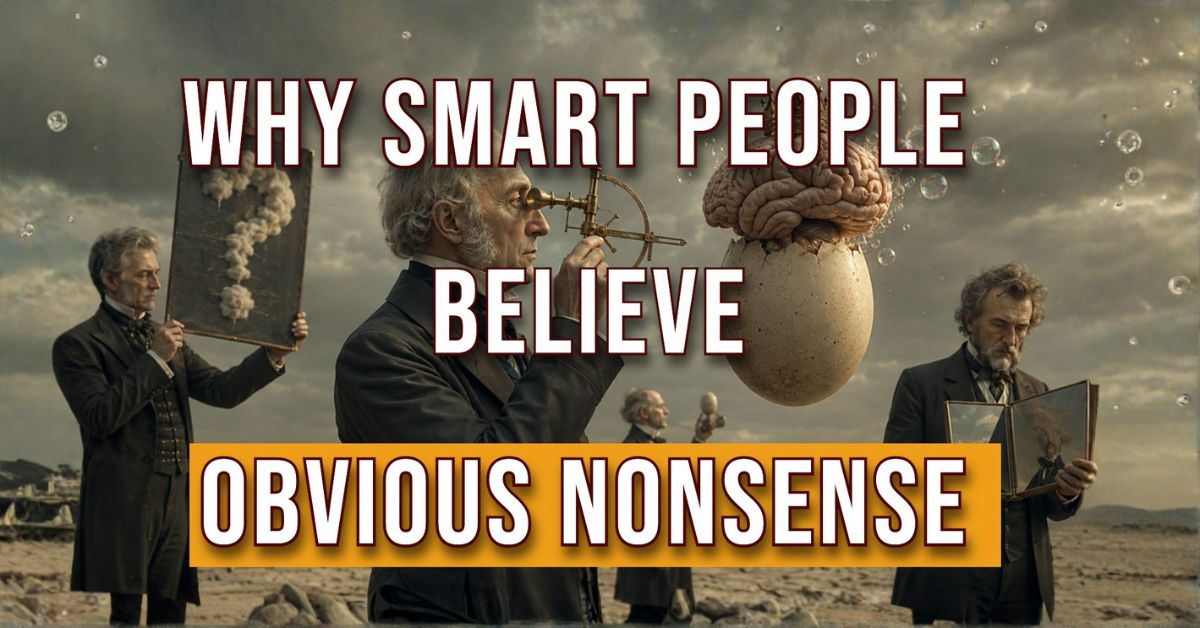
The issue is rarely intelligence. The issue is the emotional meaning people are protecting together.
She didn’t raise her voice once. That’s what I remember really stood out. A room full of people watching a product launch collapse in real time, and she was the only one smiling. This wasn’t denial; it was something far stranger to the people around the table. She had a story about what was happening, and that story was more load-bearing than the facts.
The Question Everyone Has Asked
Have you ever wondered why highly intelligent people can become absolutely convinced of things that seem obviously false to everyone outside their group?
I have.
In fact, I’ve spent decades decoding it.
Because, for most people, the more you look, the harder it becomes to explain.
You’ve probably seen it too.
The brilliant executive who defends a decision that is clearly failing; the successful entrepreneur who refuses to acknowledge the conflicting evidence before them; the political movement insisting something is true while outsiders look on in disbelief.
An entire organization can still remain convinced that a strategy is working long after the cracks are visible to everyone else.
The easy explanation is stupidity.
Except that doesn’t work.
Many of these people are exceptionally intelligent.
The next explanation is ignorance. Well, that doesn’t work either.
Many of them have access to the same information as everyone else, if not more.
Then maybe it’s manipulation. Yes, sometimes, but not often enough to explain what we’re seeing.
So we’re left with a question that becomes increasingly difficult to ignore.
How can intelligent people look at the same reality, the same evidence, the same facts, and arrive at conclusions that seem impossible for people outside their collective system to understand?
Most explanations point toward information.
The Emotional Meaning Architecture© points somewhere else entirely.
Before we talk about intelligence, facts, manipulation, or even rationality, we need to examine something deeper.
We need to examine meaning.
“They Just Don’t Have The Facts.”
The first explanation most people reach for is information.
We assume people believe obvious nonsense because they don’t know enough.
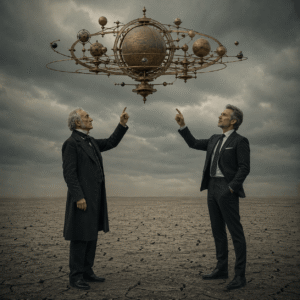 We tell ourselves that we are being kind or caring when we say, “If they had better information, they would arrive at better conclusions.” That seems to be both a logical and empathetic conclusion.
“If they had access to more facts, they would see reality more clearly.” And that’s a comforting explanation.
The problem is that it falls apart almost immediately.
Some of the smartest people I’ve ever met have had access to extraordinary amounts of information.
I’m talking about Executives. Scientists. Academics. Political leaders. Entrepreneurs. People who have spent decades studying a subject from every possible angle.
And yet intelligent people regularly become convinced of things that later prove to be spectacularly wrong.
History is full of examples.
Markets collapse despite expert confidence. Organizations fail despite years of analysis. Entire industries miss changes that, in hindsight, seem impossible to overlook.
The Clearest Example: The 2008 financial crisis.
The housing market collapsed while some of the most credentialed economists, ratings agencies, and bank executives on the planet insisted the underlying assets were sound. Lehman Brothers, Bear Stearns, and the broader mortgage-backed securities market were being defended by experts right up until they weren’t.
Meanwhile, other ‘experts’ (Michael Burry, John Paulson) saw it coming and bet against it. So the more precise claim is that institutional consensus, the collective Emotional Meaning Architecture, collapsed.
That distinction illustrates how the Emotional Meaning Architecture determines the reality we’re willing to fight for. The people who got it wrong weren’t stupid or uninformed. They were embedded in a collective system that had a story about reality (housing always goes up, these models are sound) that became more load-bearing than the data itself.
The 2008 crisis doesn’t just illustrate it. It proves it at the level of a civilizational mentality.
The issue wasn’t that nobody had the facts.
The facts were often sitting in plain sight.
What’s even more interesting is that opposing groups frequently have access to many of the same facts.
They read the same reports. Watch the same events unfold. Review the same evidence. Yet, they walk away with completely different conclusions about what those facts mean.
If information were the answer, this shouldn’t happen. More facts should create more agreement. But instead, we often see the opposite.
The more information people accumulate, the more certain they become.
And sometimes, the further apart they move.
So while information matters, it doesn’t explain the phenomenon.
Something else is happening between the facts and the conclusions people draw from them.
“They’ve Been Manipulated.”
Once the information explanation starts breaking down, most people reach for a second explanation.
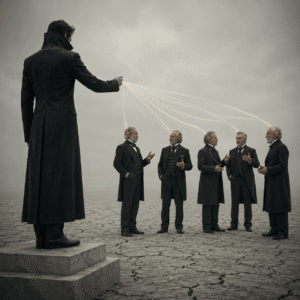 Manipulation.
Someone lied. Distorted the facts. Spread misinformation. Persuaded intelligent people to believe something they otherwise would have rejected.
And sometimes that’s true.
Human beings can absolutely be manipulated.
History provides more examples than any of us would care to count.
But once again, the explanation begins falling apart when you look more closely.
Because manipulation raises another question.
Why do some people accept it while others don’t?
Two people can be exposed to the same message. One rejects it immediately. The other embraces it completely.
If the manipulation was identical, but the response was not, why is there a variance in response?
The same thing happens inside organizations. A leader presents a questionable idea. Some people become fiercely committed to it. Others remain skeptical.
Again, the information entering the system is the same. But the response is different.
Why?
Because manipulation can influence people, but influence alone doesn’t explain why certain ideas take root while others fail.
Think about it; if manipulation were sufficient, everyone exposed to the same message would respond the same way.
Clearly, they don’t.
Something determines whether a message feels believable before people consciously evaluate its truthfulness.
Something determines why one person is convinced while another finds the same idea absurd.
Once we start paying attention to that, the question changes.
We stop asking, “Who manipulated them?” And we begin asking, “What made that message feel true to them in the first place?”
That’s a very different investigation.
“They’re Not Thinking Rationally.”
At this point, some people arrive at a third explanation.
“They’re not being rational.”
Now we’re getting closer, but not in the way most people think.
Because this explanation contains a hidden assumption.
The assumption is that intelligent people become convinced of obvious nonsense because emotion overwhelms reason.
The false assumption is that emotional people become irrational and rational people stay objective.
Except that isn’t what we actually observe.
Some of the most intelligent people in the world have defended ideas that later collapsed under scrutiny.
 It’s not because they lacked intelligence. It’s because intelligence and objectivity are not the same thing. Sometimes they move together, and sometimes they don’t.
Rational, cognitive Intelligence allows people to analyze. Interpret. Build arguments- connect dots, and maybe explain.
What intelligence does not automatically provide is immunity from distortion.
If it did, highly intelligent people would be the least vulnerable to bad ideas.
Again, history suggests otherwise.
The deeper question is not whether people are thinking. Many very smart people are thinking extraordinarily hard.
The deeper and far more interesting question that has fueled so much of my own research is: why intelligent people can look at the same evidence and become even more convinced of completely different conclusions.
That shouldn’t happen if intelligence functions as a ‘truth machine’.
Yet, it happens constantly.
The more I studied it, the more another pattern appeared.
The people most convinced they were seeing reality clearly were often the same people least likely to question the lens through which they were interpreting it.
Can you let yourself sit with that one?
Because if you can genuinely let that in, it changes the landscape of your presupposition. Because now, the issue was no longer information, manipulation, or rationality.
You will come to realize that something deeper was/is shaping all three.
Shocker: Intelligence Is Not A Truth Machine
By this point, most people become uncomfortable because we’ve eliminated the explanations they usually rely on.
It’s not a simple lack of information.
It’s not manipulation alone.
 And it isn’t that intelligent people somehow stop thinking.
So what is intelligence actually doing?
That question took me decades to answer.
Why? Because most of us grow up believing intelligence performs one primary function. We’ve been educated (maybe indoctrinated) to assume intelligence helps people arrive at the truth.
Sometimes it does. But that’s not the only thing it does.
I’ve watched brilliant people defend things that were falling apart in real time. Relationships, business, cultural politics, and a myriad of other outcomes.
Intelligence wasn’t helping them find the truth. It was helping them defend, justify, and reinforce the conclusion.
For many intelligent people, Intelligence is an unconscious mechanism for distorting reality.
The smarter the person, the more sophisticated those explanations can become.
When intelligent people become attached to a conclusion, they rarely run out of reasons. They generate more reasons, and they find supporting evidence. They construct stronger arguments and identify and point out exceptions. They will willingly explain away contradictions. Because they are intelligent, they can build entire frameworks that make their position appear increasingly reasonable.
But that’s where things become dangerous.
Because outsiders can mistake the quality of the argument for the quality of the conclusion.
They are not the same thing.
An intelligent explanation can still defend a distorted interpretation.
I’ve watched extraordinarily intelligent people defend positions that were collapsing underneath them. Not because they were dishonest or stupid.
But because human beings become remarkably creative when protecting something they cannot afford to question.
That realization changed the investigation.
The issue was never whether people possessed intelligence.
The issue was understanding what intelligence was being asked to serve.
Intelligence can help people discover the truth. But it can just as brilliantly help them defend a version of reality they have already become committed to protecting.
Look across history, and you will find far too many examples of humans brilliantly defending something that, with ten or twenty years of hindsight, seems unthinkable.
The Meaning Comes First
Have you ever had a moment of immense frustration? A moment where you are asking a question over and over that you just couldn’t get an answer to? I know that I did, at some point, I realized I had been asking the wrong question.
 I kept asking why intelligent people believe things that appear obviously false to everyone outside their group.
But intelligence wasn’t the mystery.
The real mystery was this:
Why do certain ideas feel true to some people long before they have fully examined whether they are true?
That question led me somewhere most explanations never go…
Meaning.
Human beings do not simply respond to facts. We react to what those facts mean to us.
That distinction sits at the heart of Emotional Meaning Architecture©.
Because facts, by themselves, do not tell people what to do. They don’t tell people what matters or who they are.
But ‘Meaning’ does.
Two people can look at the same event and experience entirely different realities because each is assigning a different meaning to it.
One person might see change, while another sees danger.
One sees accountability; another might see that exact same thing as aggression.
Where one person sees opportunity, another sees loss.
The event is the same; it’s the meaning that’s different.
Sometimes, the collapse of an old meaning structure is exactly what creates the conditions for transformation.
I explored that dynamic in my article, How to Break Free from Disillusionment: Discovering Your Path to Transformational Leadership.
Once meaning enters the picture (and it always does), people stop evaluating information solely on its accuracy. They begin evaluating whether it fits the meaning structure through which they already understand the world.
Does the information support what they believe about themselves?
Does it support what they believe about other people?
Does it support what they believe about how the world works?
If it does, the information feels credible.
But if it doesn’t fit that individual’s meaning structure, resistance begins almost immediately. What’s worth noting is that all this is taking place long before conscious reasoning even gets its foot in the door.
By now, you’re beginning to realize that this is why intelligent people can look at the same facts and arrive at radically different conclusions.
They are not merely processing information; they are interpreting meaning.
This is no small thing, because once meaning becomes connected to identity, belonging, certainty, safety, status, purpose, or significance, questioning it no longer feels like an intellectual disagreement; it feels personal and threatening.
Human beings do not primarily defend facts. They defend the meanings attached to them.
Once I saw that, the phenomenon I had been trying to understand for decades suddenly looked very different.
Why Smart People Believe Obvious Nonsense Together
Once meaning enters the picture, another mystery begins making sense.
Something most people have witnessed: Entire groups becoming convinced of things that seem obvious to everyone outside them.
Organizations. Political movements. Religions. Cults. Industries. Families. Social circles.
History is full of examples.
At first glance, it looks like collective ignorance. But that explanation falls apart for the same reason the others did.
 Groups do not merely share information. There is an instinctual desire to share meaning as an act of belonging.
And once people begin organizing around the same meaning structure, they begin reinforcing one another’s interpretations of reality.
What starts as a shared interpretation eventually becomes a shared ‘reality’.
And once enough people share it, questioning the meaning can begin to feel like betraying the group itself.
The more people around us assign the same meaning to an event, the more natural that meaning begins to feel. And the more natural it feels, the less likely we are to question it.
And BOOM! No one is forcing us.
Because human beings experience belonging through shared meaning.
Belonging is not primarily created by agreement.
It is created by shared interpretation. By seeing the world through a similar lens. By attaching similar meanings to events, experiences, threats, opportunities, values, and identities.
This is why intelligent people can enter a group and gradually become convinced of things they might have questioned before.
The group is not simply giving them new information. It’s teaching them how to interpret reality.
And once that shared interpretation becomes tied to belonging, questioning the group’s meaning begins to carry a cost most of us are unwilling to pay. A relational cost. An identity cost that may even feel like a matter of survival.
At that point, people are no longer protecting an idea. They are protecting their place within a collective system.
Entire systems can become organized around protecting their meaning together.
What People Are Actually Protecting
If you are someone who values ‘truth’ and, in so doing, have been willing to question what you’ve been conditioned to see ‘truth’ as, this is where the conversation becomes not only genuinely fascinating but far deeper.
You see, once a person like you begins seeing the role meaning plays, another question naturally follows.
If human beings are not primarily protecting facts, what exactly are they protecting?
The answer is rarely the thing they are arguing about.
Despite the rhetoric we’re all being sold, it isn’t the policy. It isn’t the ideology; it isn’t the strategy. It isn’t even the belief itself. All of those are usually the visible surface.
Underneath them sits something far more important.
Identity.
Belonging.
Certainty.
Significance.
Security.
Purpose.
These are the structures people use to answer two questions:
“Who am I?” and “Where do I belong?”
That’s why arguments so often become emotional long before people realize it.
Because what is being threatened is rarely the opinion itself. It is the meaning attached to the opinion, the identity attached to the meaning, and the belonging attached to the identity.
Once those become connected, disagreement starts feeling very different. A challenge no longer feels like someone questioning an idea; it feels like someone questioning the structure holding part of your world together.
Just think about it; the stronger the attachment becomes, the more energy people devote to defending it. Because human beings instinctively protect the structures that help them maintain psychological coherence. You believe something, you feel something about it, and you act like it’s true. They match. That’s coherence.
That’s why, as incongruent as a person’s argument can be, that same intelligent person can defend ideas that no longer serve them.
That’s how organizations unknowingly protect strategies that are clearly failing.
That’s why entire groups can resist the glaring realities sitting directly in front of them.
They are not simply protecting a conclusion.
They are protecting the meaning it provides.
And meaning is often more powerful than the fact itself.
Many leaders mistakenly believe emotional detachment protects objectivity. In reality, emotional suppression often hides the very meaning structures driving perception. I explored this further in Breaking Stoic Myths: Redefining Next-Gen Leadership Excellence Through Emotional Depth.
The Discipline That Explains The Blind Spot
For most of my career, I’ve watched people try to solve these problems from the outside. Most consultants, strategists, and coaches are using great tools that focus on behavior, communication, decision-making, leadership style, culture, strategy, and even emotional intelligence.
Look, all of those things matter!
But what matters more is to be aware that they are all downstream of meaning.
 Because, by the time behavior becomes visible, something deeper has already happened:
Meaning has already been assigned. Interpretation has already begun. And the lens is already shaping what feels true, threatening, important, trustworthy, dangerous, possible, or impossible.
Once we genuinely get the truth of this, which is how we operate, then the question is no longer “Why did people behave this way?”
The deeper, and far more effective, question becomes: “How did this come to mean what it means to them in the first place?”
That is the question that sits at the heart of Emotional Meaning Architecture©.
The more I studied the problem, the more obvious it became that we were missing a map.
Emotional Meaning Architecture© is the discipline that studies how emotional patterns shape the meanings people assign to reality.
Because once meaning is organized, perception follows.
Once perception follows, behavior follows on.
Most people spend their lives trying to change behavior without ever examining the meaning architecture that produced it.
Until the underlying meaning architecture is examined, the same patterns simply reappear in different forms. The Emotional Source Code Protocol was designed to address the deeper structures that shape perception, identity, and behavior.
And that is one of the reasons the same conflicts, distortions, and patterns keep reappearing in different forms.
The surface changes.
The architecture underneath often remains untouched.
In Conclusion
Let’s go back to the question we started with.
Why can highly intelligent people become absolutely convinced of things that seem obviously false to everyone outside their group?
The answer is not intelligence, information, manipulation, or irrationality.
All of those things can play a role. But none of them completely explain the phenomenon.
What explains it is meaning!
The meanings people attach to themselves about who they are, and where they belong. Which determines the meanings they attach to other people.
The meanings they attach to belonging, identity, certainty, purpose, status, security, leadership, success, failure, and truth itself.
Once those meanings become established, they begin shaping perception.
And once perception is shaped, reality no longer feels like an interpretation. It feels like an undeniable reality.
That’s the part most people miss. It’s the reason that every opening conversation I have with a potential client, whether it’s an individual running a multi-national organization, a political figure, or someone with throngs of adoring fans, engaging in the Emotional Source Code Protocol is not only the most courageous thing you have ever done, but it will also be the most transformative experience of your life.
The interpretation disappears, and only the certainty remains.
That is why intelligent people can defend ideas that no longer serve them.
That is why organizations can repeat mistakes that seem obvious in hindsight.
That is why entire groups can become convinced of things that outsiders struggle to understand.
Have compassion, recognize that the issue is rarely intelligence.
The issue is the emotional meaning people are protecting together.
And until we learn to examine the meanings that shape our perception, we will continue mistaking emotional certainty for Truth.
TL;DR
Human beings do not primarily defend facts.
They defend the meanings attached to those facts.
That is why intelligent people can look at the same evidence and arrive at radically different conclusions. Information, manipulation, and rationality all play a role, but they do not fully explain why people become convinced of ideas that appear obviously false to others.
The missing variable is meaning.
People interpret reality through meanings connected to identity, belonging, certainty, purpose, security, and significance. Once those meanings become emotionally important, questioning them no longer feels like an intellectual exercise. It feels personal.
The issue is rarely intelligence.
The issue is the emotional meaning people are protecting together.
Q&A
Q: Why can intelligent people believe things that seem obviously false?
Because people do not respond to facts alone. They respond to what those facts mean to them. When meaning becomes tied to identity, belonging, or certainty, intelligence often helps defend the meaning rather than question it.
Q: What does Emotional Meaning Architecture© explain that other approaches miss?
Emotional Meaning Architecture© examines how emotional patterns shape the meanings people assign to reality. Meaning influences perception long before conscious reasoning begins.
With gratitude, respect, and curiosity,
Dov…