(The Question That Stops High Performers Cold)
We all have habits we like to erase; some are secret, others are glaring, but why, when we are intelligent, accomplished people, do we keep those habits that are clearly costing us more than they appear to offer?
He was exactly the kind of man people assume has no inner obstacles.
At fifty-three, he ran a company with hundreds of employees. The board trusted him. Investors called him disciplined. Friends described him as calm under pressure. He had built businesses, raised children, survived recessions, and sat across the table from people whose names regularly appeared in media that recognized the best of the best in any industry.
And yet, for almost four years, a document sat unfinished in the top drawer of his desk.
It wasn’t a novel, a business plan, or a legal dispute.
It was twelve pages.
Twelve pages outlining the thing he wanted to build next.
He had already done the research. He’s already mapped the market and spoken to the best advisors. He knew exactly what to do.
 Every quarter, he reopened the document. He adjusted headings, refined the language, added notes, and expanded sections.
Then quietly put it away again.
One afternoon, during one of our regular meetings, I finally asked him a question neither of us expected.
“What happens if you finish it?”
He laughed; I didn’t.
He stopped laughing.
The room went quiet.
It was one of those moments where the silence was deafening, because the answer had nothing to do with money.
Or risk.
Or capability.
Finishing it would mean visibility-being seen for who he truly is-and that fear of judgment or losing status can deeply hinder progress, even for the most accomplished.
He was a man of status and a certain reputation, and yet, it would mean
becoming something deeper than the role his family, his friends, and his reputation had always expected him to occupy.
 Beneath all of his intelligence, experience, and strategic brilliance was a seven-year-old boy’s conclusion:
Stay impressive.
Do not become difficult.
Do not outgrow the group you belong to.
The project was never the threat.
The future was.
And that, my friend, is the strange pain many highly capable people carry.
It’s not the pain of inability, it’s the pain of standing at the edge of their next life while some older part of them quietly reaches back and pulls.
Familiar
Unless you’ve experienced it, it might seem inconceivable, but I want to reassure you that there is a specific kind of pain that doesn’t come from being incapable.
It comes from being very capable and still stuck.
These highly accomplished people can explain themselves clearly and see their patterns with precision, but this heightened self-awareness can sometimes lead to overthinking, which can fuel resistance to change.
They can explain themselves clearly. They can see the shape of their own life with unusual precision. They know what would improve things: the project that ‘should’ be built, the conversation that ‘should’ be had, the next level that ‘should’ be claimed.
And yet, when the moment comes to do it, something happens.
They stall. They distract themselves. This highly capable individual suddenly feels overwhelmed by the task’s size, even though it is objectively manageable. So, they tidy, refine, research, plan, and think. But they don’t fully build; they don’t fully step into that calling. They do not fully cross the threshold that would meaningfully, soulfully improve their lives.
People on the outside often mislabel this as self-sabotage.
What usually happens is something that makes no sense to anyone outside that individual. If you feel an incursion of resonance with this, it’s important that you know you are not alone in this, and what happens is a form of threat protection.
And that distinction changes everything.
What the system is doing
The brain and nervous system of human beings are not organized around happiness. The brain isn’t focused on how happy you or I might be; that’s not the imperative. The brain organizes itself around survival. When a situation poses a threat, the stress system activates, preparing the body and mind to respond.
Please note I said, ‘resembles danger.’ The danger does not have to be real at this moment. The ‘danger’ signal is written into the individual’s Emotional Meaning Architecture long before that individual has the emotional maturity to discern real danger from perceived danger.
That response was no doubt useful in some genuinely dangerous situation in that person’s history. Still, when it becomes repetitive or prolonged, it can turn maladaptive and will distort behavior, cognition, and emotion.
 So when a person freezes before expanding, the issue is usually not a lack of intelligence or desire. It is that some part of the system has detected risk/danger.
That risk may be obvious, but it might also be concealed from the person’s conscious mind. The ‘threat’ may be financial, social, relational, or internal. But for many people, the most serious threat is not the work itself. You deserve to recognize that the meaning of the work triggers resistance.
For example, it could be something like:
If I succeed, will I be visible?
If I build this, will I be judged?
If I make more money, will I lose my tribe?
If I become who I know I could be, will I still be recognizable to the people who formed me?
In that sense, resistance is not random. It is protective. It is trying to prevent a future that the nervous system has labeled unsafe.
The original environment
These patterns are often rooted in formative conditioning.
A child-survival system very quickly learns what earns approval, what invites shame, what creates tension, and what must be suppressed to preserve connection.
 If a child grew up in a context of criticism, unpredictability, emotional volatility, punishment, neglect, or other forms of relational danger, the brain and body adapted accordingly. That child developed strategies for staying safe, acceptable, under the radar, or in control.
In the context of being a child in such a situation, those strategies may have been brilliant. They may have protected the child from humiliation, conflict, abandonment, or overwhelm. But the unconscious mind has no chronology; it does not keep a neat calendar of when those lessons were formed. Because the subconscious mind has no chronology/clock, the way the conscious adult wishes it did. It can continue treating old conditions as if they were current conditions. A danger that was real at seven can still be felt at thirty-seven, fifty-seven, eighty-seven, as if it were immediate.
This is why the very capable adult can be sitting in a stable life, with resources, options, and evidence of safety, while their body still acts as though expansion is a threat.
The old protection has not become stupid.
It has become outdated in a mind that cannot separate the past from the present or the future.
Why The Habit Persists
The most painful part is that the thing limiting the person is often also the thing protecting them.
This is why habits that look destructive can be so hard to remove. A habit is rarely just a habit. It may be regulating anxiety, preserving identity, maintaining familiarity, and preventing a feared consequence all at once.
If the person has depended on procrastination, perfectionism, or emotional deferral for years, then that pattern is not merely blocking growth. It is helping them tolerate life as it has been.
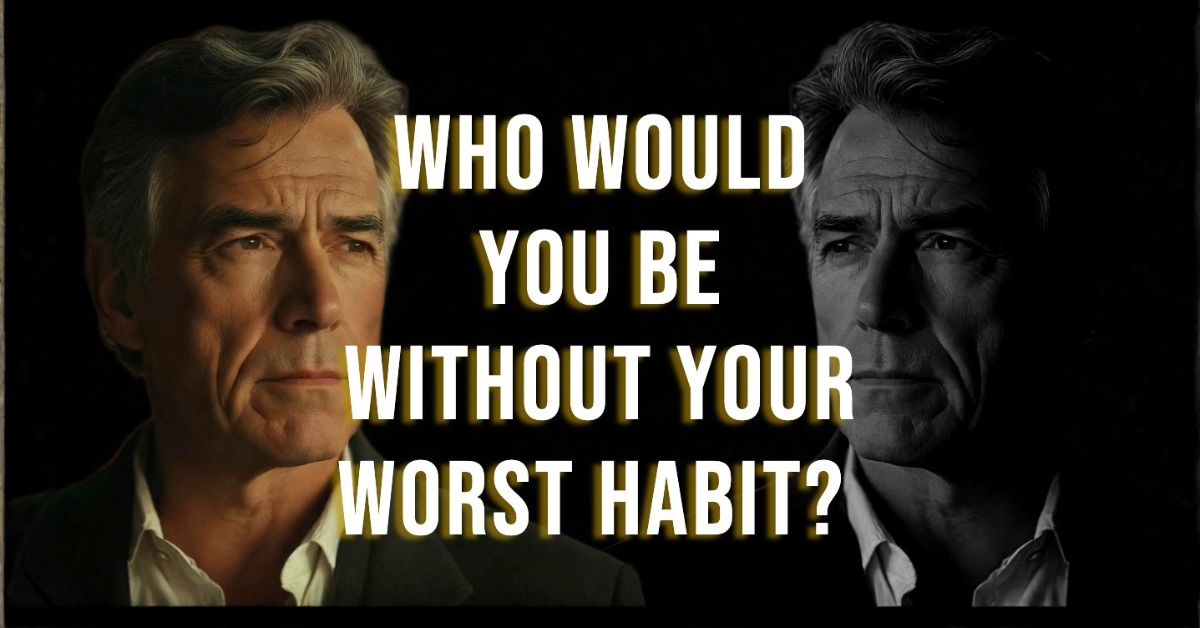
This is also why the question “Who do you think you’ll be without your worst habit?” can be so unsettling.
Because the answer is not obvious, rationally speaking, without the habit, who are you? More free, yes.
But, at the level of your Emotional Meaning Architecture, where Emotional Logic rules, you are also less defended.
More alive, yes, but also less buffered.
And for a nervous system that has learned safety through constriction, the loss of the habit can feel like the loss of protection itself.
The Double Bind
Anthropologist and social scientist Gregory Bateson’s concept of the double bind helps explain the trap. A double bind is a situation in which every available choice feels wrong, leaving the person in a no-win situation and unable to find a clear path out.
For example, if speaking up brings criticism and staying quiet does too, then the system learns that the action itself is dangerous.
That is the emotional logic of many people who appear chronically stuck.
They are not simply avoiding effort. They are trapped in conflicting demands.
Move forward, and you risk exposure. Stay still, and you risk stagnation.
Be visible, and you risk criticism. Stay hidden, and you risk disappearing from your own life.
When every path seems to carry a cost, the nervous system often chooses the option that feels most familiar. Familiarity may not be fulfilling, but it can still feel safer than uncertainty.
The cost of staying protected
 At first, staying stuck can look like a tolerable compromise.
Life is already good enough. The person functions. They are not in immediate crisis. They may even be admired for their competence. But there’s a hidden cost to living below your capacity.
There’s the cost of background anxiety, because unexpressed potential does not disappear; it lingers. There’s the cost of self-trust erosion, because every avoided move quietly teaches the brain that your intentions are unreliable.
There’s the soulful cost of this internal friction, because part of you knows you are capable of more, while another part keeps enforcing the ceiling.
Additionally, there is the cost of identity shrinkage, in which your life slowly becomes organized around what you can safely tolerate rather than what you can meaningfully build. Of course, that may preserve stability, but it sacrifices the vitality of genuine self-expression.
What actually helps
In such an individual, external recognition and applause are often secretly mirrored by an internal dialogue of self-loathing. As you can imagine, that’s not a path to anything good.
The most useful response is not to attack the protective pattern. That usually increases threat and strengthens the very thing you are trying to change. Instead, the goal is to make the nervous system feel safe enough to move. That means working at the levels of state, behavior, and identity simultaneously.
Cognitive-behavioral approaches are useful here because they focus on present thoughts and behaviors and emphasize active practice between moments of insight. In plain language: you do not think your way into a new life. You practice your way there. That being said, cognitive-behavioral work cannot address your Emotional Meaning Architecture.
Seven Actions:
Name The Threat Correctly
Stop calling every resistance pattern self-sabotage.
Instead Ask:
What threat might my system be trying to protect me from?
This single question can change the emotional tone of the entire process. It moves you out of shame and into investigation. It also helps you distinguish between real danger and remembered danger.
Shrink The Task
Overwhelm grows when the task is vague, large, and identity-charged.
Do not ask, “How do I change my life?” At an identity level that computes as a self-destruct message.
Instead, ask, “What is the smallest next action that would count as movement?”
Send a message? Read/write a page? Make a call? Make a small decision? Block 20 minutes to do something. The brain is much more willing to engage when the next step is concrete and finite.
Regulate Before You Build
If the body is in threat mode, the mind will work harder but less effectively.
Before starting, do something that lowers arousal:
- Slow exhalation breathing.
- A short walk.
- Run your wrists under cold water.
- Stretching or shaking out tension.
- Reducing noise and visual clutter.
- Putting the phone away.
This is not a wellness ritual. It’s regulating your nervous system in preparation for cognition.
Act Before You Feel Ready
Highly self-aware people often wait for internal certainty before taking action, and that’s a trap.
As much as we tell ourselves, ‘I’ll do it when I’m ready,’ readiness usually follows action, not the other way around. A small move gives the nervous system new evidence. A new experience begins to overwrite the old prediction.
Reward Completion, Not Idealization
Perfectionism often disguises itself as high standards, but, in practice, it keeps the person in suspended animation. Train your brain to value completed work over imagined excellence. Finished (even at the level of ‘good enough’) is neurologically powerful because it creates proof. Proof changes expectation. Expectation changes behavior.
Track Evidence of Safety
Your system updates through repetition. Therefore, keeping a simple log of moments when you moved, even though you felt resistance, can be very effective. Do not record only the outcome. Record the act itself.
For example:
- Sent the email despite anxiety.
- Started the draft before I felt ready.
- Made the call before I had certainty.
- Finished the first version instead of polishing forever.
This matters because the brain learns by accumulation. You are building a new narrative from evidence.
Developing a Different Relationship to Change
The deeper work is not to become someone else. It’s to become someone for whom expansion is no longer interpreted as danger.
That requires compassion for the part of you that resists. That part of you existed for reasons that were once very real and valid. It may have saved you from a world that was too volatile, too punitive, too exposing, or too unpredictable. The goal is not to force that part into obedience. The goal is to update it.
So…
Tell the truth to yourself: We are not there anymore. The old danger was real. The old response made sense. But the present is not the past.
That may sound simple, but it’s one of the hardest transitions a human being can make: to stop living as if the current moment must obey the rules of an earlier one.
The Real Breakthrough
The threshold you keep approaching and backing away from is probably not external. It’s the need for internal permission. And again, this is emotional logic, so it’s not a rational permission.
It’s the point at which your nervous system can tolerate you owning success, visibility, capacity, and impact beyond your current identity, without assuming catastrophe will follow.
 Until then, even the most externally successful person will keep circling the edge of their next life. Not because they are unwilling, but because some part of them is still trying to keep them safe. And because all of this is going on inside the Emotional Meaning Architecture of the individual, the answer is never brute force.
It is evidence, regulation, repetition, and a more honest relationship to the original wound.
Once the nervous system learns that safety no longer requires shrinking, the person does not just perform differently; they become a different person.
They begin to become different.
That is the real work.
Not defeating the protector.
Educating it.
And once it learns, gradually and repeatedly, that the world has changed, the life that once felt inaccessible becomes livable.
TL;DR
Many of the habits we call self-sabotage are actually protection systems built long ago to keep us safe. The problem is that what once protected us can later prevent us from becoming who we are capable of being. Real change does not come from defeating these patterns. It comes from understanding the emotional logic behind them, creating evidence of safety, and teaching the nervous system that expansion no longer equals danger.
Q&A
Q: Why do intelligent, capable people stay stuck even when they know what to do?
Because the obstacle is rarely a lack of knowledge. More often, the nervous system interprets growth, visibility, success, or change as a threat and activates old protection strategies.
Q: What is the real breakthrough?
The breakthrough occurs when your nervous system no longer interprets expansion as danger and can tolerate greater visibility, capacity, impact, and success without expecting catastrophe.
With gratitude, respect, and curiosity,
Dov…