AI, Quantum Computing, and The Human Advantage
The rapid advances in Artificial Intelligence models and the potential of quantum computing are nothing short of awe-inspiring, offering a promising glimpse into the future of technology and human potential.
If you’re fascinated by these developments, consider this: AI, in its current form, is like a child in its third year of kindergarten, yet it already possesses the knowledge equivalent to multiple Ph.D.s.
Humans have an average IQ of around 100. AI already has an IQ of 120, and if you think that’s not a big deal, consider the fact that it has that 120 IQ in every subject! Moreover, AI’s IQ is not stagnant; it keeps growing constantly.
Is Willow The Answer to The Quantum Dilemma?
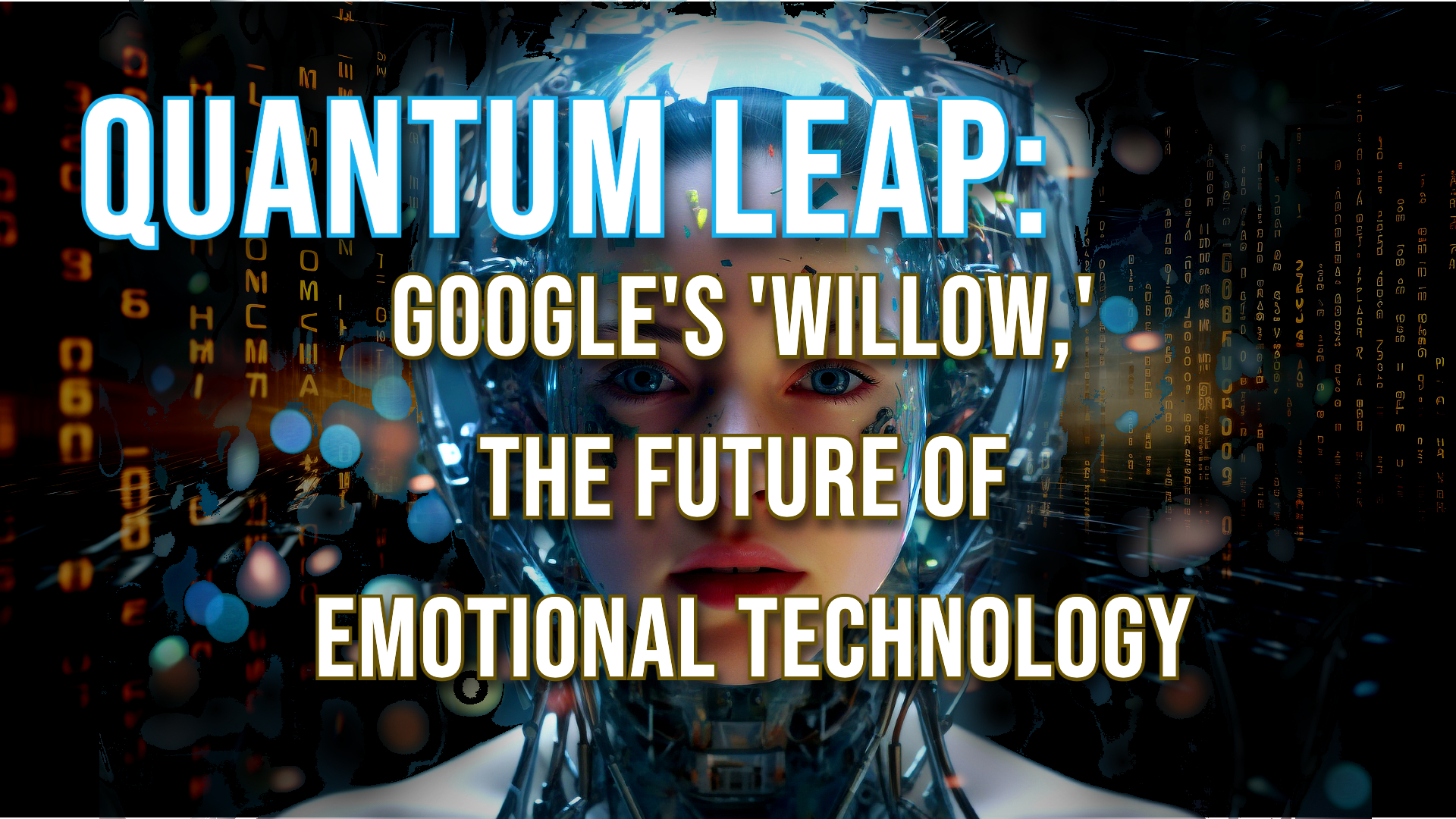
As if AI IQ wasn’t enough, in December 2024, Google announced the release of its quantum processor, “Willow.” Quantum computing’s integration with artificial intelligence (AI) is poised to revolutionize the field, offering significant advancements and implications across various domains. For example, a long-held scientific dilemma has been around superpositioning and the “many-worlds” theory of quantum mechanics. Willow directly confronts this dilemma in its ability to process in the way it does. Let me explain…
One way to think about Quantum Superposition is to picture a spinning coin. While the spinning coin is in the air, it appears to be both heads and tails. Only when you catch it and look at it can you see whether it’s heads or tails. Superposition shows how things can exist in multiple states until we observe them!
Furthermore, because of quantum computations, the “many-worlds interpretation of quantum mechanics” proposed by Hugh Everett III in his 1957 PhD thesis at Princeton University suggests that we might live in a holographic reality.
If you missed it, let me give you a refresher on Google’s new Quantum processor, Willow, and how the aforementioned theories of quantum mechanics are tied to what Willow can do. Willow performed a computation in five minutes that would take one of the fastest supercomputers we have today ten septillion years (for context, a million years is 1, followed by six zeros. Ten Septillion is 10,000,000,000,000,000,000,000,000, which exceeds the age of the universe).
Imagine waking up tomorrow to discover that every major decision you’ve ever made—every career move, every relationship choice—could be solved in less time than it takes you to tie your shoes. Google’s ‘Willow’ just proved it’s possible.
The only thing it won’t solve? Your unresolved emotional loops. For that, you’re on your own.
When you or I have to decide between multiple options, the many-worlds interpretation of quantum mechanics suggests that all possible outcomes of that specific event happened in a parallel universe. This interpretation, proposed by Hugh Everett III, implies that every possible decision outcome exists in a separate universe. This has profound implications for AI’s understanding and replication of human emotions, as it suggests that AI could potentially simulate and understand the emotional consequences of different decisions in a way that is currently beyond its capabilities.
In the simplest language possible, the many-worlds interpretation of quantum mechanics states that there is a universe in which every decision has every potential outcome.
Asking AI To Feed Your Dead Cat
In 1935, Austrian physicist Erwin Schrödinger introduced a thought experiment highlighting the peculiarities of quantum mechanics. He envisioned a cat placed inside a sealed box containing a device that had a 50% chance of causing the cat’s death within an hour. Until the box was opened and observed, the cat existed simultaneously as alive and dead.
This scenario demonstrates the concept of superposition in quantum mechanics, where particles can exist in multiple states at once until observed.
Schrödinger’s cat experiment illustrates that particles can occupy multiple states simultaneously in the microscopic realm of quantum particles. However, in our macroscopic everyday world, those particles or masses of particles (objects) exist in definite, observable states.
If the subject intrigues you, research the Schrödinger’s cat experiment.
The fundamental question that arises from much of quantum mechanics is, “What is the role of the observer?” Are we changing the outcome of what we perceive as reality merely because we observe it and give it meaning?
This sounds like an off-the-wall sci-fi story, but the truth is, it’s all profoundly embedded in science.
AI can navigate logic like GPS. But emotional mastery? That’s a jungle with no map. If you’re not hacking away at the vines of your Emotional Source Code– the deep-seated beliefs and experiences that shape your emotional responses-you’re not leading—you’re lost.
The AI Emotion Dilemma
An area of artificial intelligence that has been particularly challenging to develop is how AI understands the most everyday part of what makes us human: emotion. Certainly, artificial intelligence has gotten pretty good at mimicking an emotional response, but that’s what it is—an amateur impersonation.
However, there are two key factors for us to pay attention to: First, with recent advances in quantum computing, the ‘AI emotion dilemma’-the challenge of how AI understands and replicates human emotions- will eventually be resolved. Quantum computing’s ability to process vast amounts of data and simulate complex systems could provide AI with the computational power it needs to understand and truly respond to human emotions. Secondly, most humans have little understanding of their emotions, what drives them, and how to manage and use them for favorable outcomes. Yet, in many ways, the more technologically advanced we become, the more valuable it is for humans to understand our emotions.
What’s clear to me is that AI can “outlogic us” already, but the infinite complexities of subjective emotion and, therefore, meaning separates humanity from machines.
Understanding and mastering our emotions is becoming increasingly valuable in the age of AI, enlightening us about the unique value of our human experience. As the relentless wave of artificial intelligence (AI) continues to surge—now turbocharged by the unimaginable power of quantum computing—humanity stands at a pivotal crossroads. This technological evolution isn’t just altering industries—it’s reshaping the core of the human experience.
We are witnessing unprecedented changes in how we work, communicate, solve problems, and make decisions. But amid this seismic shift, one distinctly human capacity is skyrocketing in value: emotional self-mastery.
The Ultimate Call to Mastery
AI will surpass humans in speed, efficiency, and logic.
But if you think speed, efficiency, and logic are all that matter, you’ve misunderstood the human experience entirely.
AI can master logic.
Humans must master meaning.
AI can track behavior.
Humans must master the why behind their behavior.
AI can predict choices.
Humans must master choice itself.
If you aren’t mastering your Emotional Source Code, you’re not leading—you’re a puppet, dancing to the strings of past wounds and inherited fears.
The ability to rewrite your emotional script is not just a personal advantage—it’s generational. This is how we break free from inherited emotional wounds, generational trauma, and cycles of burnout.
Leaders, Innovators, and Changemakers
Leaders, innovators, and changemakers who understand their Emotional Source Code will be the architects of the future. They will not be followers of algorithms but the creators of meaning.
As machines master logic, human mastery of meaning becomes the ultimate competitive advantage.
If you think this is “nice to have,” you’ve missed the point.
If you think this is “soft,” you’re already behind.
You will be replaced if you think you can delegate this to AI.
Here is your call to action:
- Master your Emotional Source Code, or it will master you.
- Lead with heart, or be led by habit.
- Master meaning, because machines never will.
The future won’t be shaped by those who are faster or more intelligent.
The future will be shaped by those who are more human.
The question isn’t whether AI will change the world—it already has.
The real question is: Will you change with it?
Master your Emotional Source Code.
Not just for you—but for everyone you lead.
This is your edge.
This is your legacy.
And it starts now.