

Why You Cannot Build a Culture of Belonging Without Perception Mastery
Leaders say they want belonging.
They invest in engagement systems.
They redesign values.
They launch inclusion initiatives.
And still something feels thin.
Candor weakens. Innovation slows. Alignment becomes suspiciously smooth.
Here is the structural truth:
Belonging does not collapse because of weak culture design.
It collapses because of distorted perception.
I know, you were told a lie, we all were, but the truth is, culture does not begin with values.
It begins with interpretive architecture.
If perception is distorted, culture will mirror the distortion.
Always.

The Structural Law
The Law of Cultural Reflection:
An organization will not exceed the perceptual capacity of its leadership.
If leaders cannot tolerate dissonance, the culture will suppress it.
If leaders defend identity over truth, the culture will reward agreement.
If leaders misinterpret silence as alignment, the culture will perform compliance.
Belonging is not engineered; it’s reflected.
For a deeper look at how leadership blindness leads to institutional collapse, see Every Empire Falls the Same Way: When The Leader Stops Seeing What’s Real.
TL;DR
Culture is the visible expression of leadership perception. Distorted perception produces conditional belonging.
The Mechanism: How Perception Rot Becomes Conformity
Perception Rot begins with success.
Success reinforces identity.
Identity strengthens emotional filters.
Emotional filters shape interpretive architecture.
Interpretive architecture determines what leaders see as threat or value.
Here is the causal chain:
Emotional filters → interpretation → leadership reaction → cultural signal → organizational behavior
That’s Emotional Meaning Architecture in motion.
 When distortion is no longer episodic but systemic, perception work alone is not enough. It requires full Emotional Source Code intervention.
When a leader’s emotional filters interpret dissent as destabilization, the reaction becomes defensive. The defensive reaction becomes a cultural signal. The cultural signal becomes the behavioral norm.
People adapt to survive the signal.
Conformity is not mandated; it’s inferred.
But the hard truth we, as leaders, must face is that belonging cannot exist in the face of inferred risk.
Why Leaders Believe the Culture Is Healthy
 There’s a funky smell in the kitchen, and you can’t work out where it’s coming from, and eventually you bring in an expert. The builder pulls out the wall behind the sink, and the smell becomes unbearable. The building expert tells you to get out. Mold and rot are eating through your structure. Just like Perception Rot in your organization, it is quiet and destructive.
Unlike the rot in your walls, Perception Rot does not announce itself.
It disguises itself as:
Efficiency.
Speed.
Decisiveness.
Strategic clarity.
Meetings become shorter. Debates become lighter. Agreement becomes faster.
Leaders celebrate momentum.
But momentum without contradiction is sedation.
If disagreement feels rare, it is not because alignment is strong.
It is because emotional filters have narrowed the interpretive field.
For more on why legacy culture models no longer work, see Is Traditional Corporate Culture Obsolete?
When the Emperor’s Blindspot activates, leaders no longer see what they are no longer being told.
That is not cultural failure: It’s perceptual distortion.
TL;DR Perception Rot makes conformity feel like alignment. Silence becomes a symptom of distortion, not proof of trust.
Identity Defense: The Hidden Driver
Most leaders do not intentionally suppress belonging.
They defend identity.
“I built this.”
“My clarity made this possible.”
“My judgment is proven.”
 When feedback challenges that identity, the nervous system reacts before cognition.
Irritation precedes inquiry.
Defense precedes reflection.
Certainty precedes recalibration.
Meaning always precedes behavior.
When identity is fused with authority, dissent threatens self-definition.
Emotional filters then edit reality to preserve a semblance of coherence.
This is not ego in the cartoon sense.
This is internal governance protecting stability.
But when internal governance prioritizes identity over truth, belonging becomes conditional.
People learn:
Speak carefully. Disagree softly. Do not destabilize the leader.
That is not belonging!
That’s adaptive compliance.
For more on how leadership perception impacts organizational outcomes upstream, see Leadership Does Not Fail at the Level You Think It Does.
TL;DR: When identity outranks truth inside leadership perception, belonging narrows into compliance.
Sovereign Leadership and the Capacity for Belonging
Belonging is not a diversity tactic.
It is a Sovereign Leadership outcome.
Sovereignty is perceptual stability.
A sovereign leader can:
- Hear contradiction without fragmentation
- Publicly recalibrate without losing authority
- Separate identity from interpretation
That capacity weakens emotional filters and expands interpretive architecture.
When leaders model Perception Reset, culture expands.
When leaders defend distortion, culture contracts.
Sovereign Leadership is not dominance.
It is the ability to face dissonance without defensive governance.
Without that, belonging cannot stabilize.
The Cultural Cost of Unexamined Filters
When Perception Rot persists:
- Innovation declines because dissent feels risky.
- Trust erodes because honesty costs safety.
- Cognitive diversity narrows because difference triggers friction.
- Engagement becomes performance.
 Externally, everything looks functional. But internally, authenticity declines.
Belonging requires truth tolerance, and truth tolerance requires Perception Mastery.
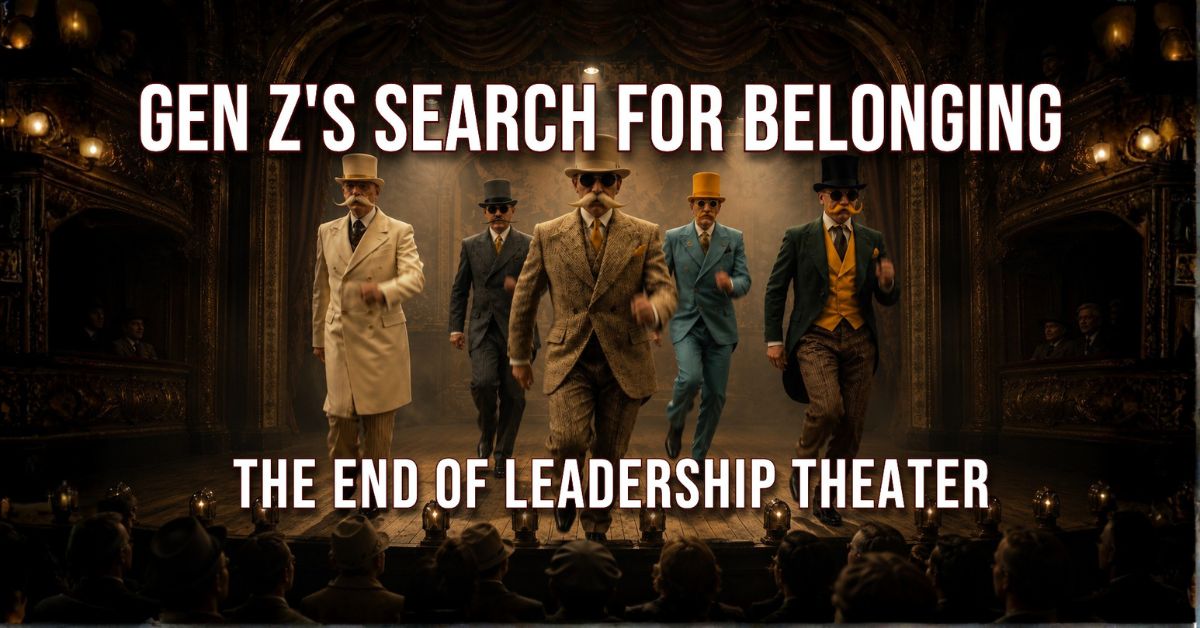
Without Perception Mastery, belonging becomes theater.
It can be branded, but it cannot be sustained.
TL;DR Belonging requires leaders who can tolerate truth without distortion. Without Perception Mastery, culture becomes choreography.
Perception Reset as Cultural Intervention
Most organizations attempt culture repair externally. Workshops. Listening tours. Values refresh.
But if emotional filters remain intact, every intervention will be absorbed by the existing interpretive architecture.
Nothing changes structurally.
Perception Reset must precede culture redesign.
Courageously ask yourself:
When was the last time someone contradicted you without hesitation?
Who has grown quieter around you?
What interpretation are you protecting because it confirms your authority?
If dissent feels disrespectful, Perception Rot is active.
If silence feels efficient, the Emperor’s Blindspot is engaged.
Clarity is not inspirational; it’s destabilizing. But it restores governance.
When leaders publicly recalibrate perception, internal governance shifts. The cultural signal changes immediately. Truth becomes safer than performance.
And genuine belonging becomes structurally possible.
The Canonical Reframe
Stop asking how to build belonging.
Start auditing your interpretive architecture.
 Belonging does not fail because people lack goodwill.
It fails because leaders misperceive reality and transmit that distortion through internal governance.
Culture is not built.
It is mirrored.
And perception is the mirror.
Final Reflection: Perception Mastery Is Not Optional
Collapse does not begin in rebellion. It begins in blindness.
Belonging does not die in crisis. It dies in filtered rooms.
You cannot build a Culture of Belonging while protecting emotional filters that distort reality.
Perception Mastery is not optional. It is the prerequisite. Because every organization becomes the emotional and cognitive echo of its leadership. And how you see determines what survives.
Q&A: The Belonging Diagnostic
Q: We have strong engagement metrics. Why question perception?
Metrics measure activity. They do not measure interpretive distortion. If disagreement is rare, your emotional filters may be narrowing the field.
Q: How do I detect the Emperor’s Blindspot?
Notice your reaction speed. If feedback triggers defense before curiosity, distortion is active.
Q: Can strong authority coexist with belonging?
Yes. Fragile authority cannot. Sovereign Leadership expands belonging because it separates identity from interpretation.
Q: What is the first sign of Perception Reset?
Public recalibration. When leaders visibly adjust interpretation, truth tolerance expands immediately.
Q: What happens if I ignore this?
Your organization will remain efficient. It will quietly lose candor. And you will not see it until the cost becomes visible.
With gratitude, respect, and curiosity,
Dov…



4 thoughts on “Belonging Dies in Blind Spots”
Pingback: clindamycin in the United States
Pingback: Adcirca generic bioequivalence
Pingback: diflucan pain medication
Pingback: levitra generic