Human beings do not primarily seek happiness. They seek emotional familiarity.
There’s a Contradiction Everyone Has Witnessed
Every human being has watched someone protect the very thing that was hurting them.
Not accidentally.
Not briefly.
Repeatedly.
You’ve seen the woman who keeps returning to the relationship that slowly dismantles her sense of self.
Everyone around her can see the damage. Eventually, even she can see it. Yet each time she leaves, something inside her pulls her back toward the very thing she swore was destroying her.
You’ve seen the executive who finally reaches the level of success they spent twenty years chasing, only to become restless the moment life grows calm. They start seeing conflict everywhere, turning small problems into large ones. Stability itself begins to feel unbearable to them. And yet, when the thing they claim to want finally arrives, they cannot receive it.
You’ve seen the leader who says they want honest feedback, then quietly punishes the people courageous enough to tell the truth.
You’ve seen families repeat the same emotional patterns across generations while everyone inside the system swears they want things to change.
You’ve likely seen it in yourself too.
A person finally experiences genuine love, yet cannot stop searching for signs that it will disappear.
Someone leaves a chaotic environment, then feels strangely anxious inside peace.
Another spends years praying for more time with their children, only to remain emotionally absent once that time finally arrives.
None of this makes logical sense.
That is what makes it so difficult to confront honestly.
Because if human beings were primarily driven by happiness, growth, connection, peace, or self-preservation, many of these patterns would collapse once they became painful enough.
But they do not collapse.
Very often, they deepen.
People will tolerate extraordinary levels of suffering to protect something emotionally familiar.
Don’t rush past what you just read by thinking it’s not about you. I promise you that if you don’t believe you’ve ever done it, you certainly know how people you love have.
Even when they consciously know better.
Even when the pattern is exhausting them.
Even when the cost becomes painfully visible.
Most people assume this happens because humans are irrational, damaged, stubborn, afraid, or incapable of change.
Those explanations are too shallow and neuropsychologically incorrect.
Something deeper is operating underneath it.
Something most people never fully see because they mistake it for personality, chemistry, instinct, identity, or simply “the way life is.”
Why Logic Never Fixes It
Human beings are not nearly as logical as we desperately want to believe.
If logic alone could change people, most suffering would end the moment ‘it’ became painful enough.
The alcoholic would stop after the second divorce.
The burned-out executive would finally slow down after the first hospital visit.
The person trapped in a destructive relationship would leave the moment the emotional damage became undeniable.
But you and I both know, life does not work that way.
Most people already know many of the things that hurt them.
Therein lies the paradox.
Problem + Insight rarely equals transformation!
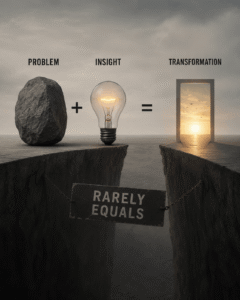 The problem is that insight and transformation are not the same thing.
Even the most intelligent person can intellectually understand a pattern while remaining emotionally organized around it.
That explains why highly intelligent people repeatedly sabotage themselves in ways they themselves cannot fully explain; why some people defend identities that are exhausting them; why organizations continue operating inside systems everyone privately knows are failing; and why families pass emotional pain through generations while promising their children, “I’ll never do to you what was done to me.”
Logic primarily speaks to the conscious mind.
However, almost all human behavior is not consciously governed, at least not for more than a moment.
Long before we develop language, ambition, politics, or personal philosophy, something else is already forming underneath all of it.
An internal emotional structure begins teaching us:
what feels safe,
what feels dangerous,
what earns love,
what creates belonging,
what must be avoided,
and what passes as normal.
None of which is rational/logical, it is built into our primal psychology.
Most people never fully realize how much of their adult life is still being organized around those early emotional realities.
We tell ourselves and others that it’s personality, instinct, chemistry, preference, or “just who I am.”
Here’s the news: It’s not!
The Hidden Priority of the Human System
On the surface, it looks like we are all in pursuit of happiness, but at our most basic psychological roots, humans do not primarily organize their lives around happiness.
I understand that this may sound offensive at first, because nearly everyone claims to want happiness.
Yet if happiness were truly the primary organizing force of human behavior, we would not repeatedly destroy peace to return to emotionally familiar environments.
And we do, and we do it all the time.
For Example:
 A person raised around emotional unpredictability may later find calm relationships strangely uncomfortable. Not because calm is bad, but because their nervous system never learned how to interpret consistency as emotional safety.
Someone raised around criticism may become suspicious of genuine praise.
A leader who grew up equating struggle with worthiness may unconsciously recreate crisis after crisis long after survival is no longer necessary.
To be clear, this is not because this individual consciously wants suffering.
But because emotional familiarity creates internal coherence.
Even painful coherence.
What does that mean? What feels familiar often feels true.
Not objectively true, but certainly emotionally true.
Once something becomes emotionally familiar enough, the human system begins protecting it automatically.
That protection is completely unconsciously driven to push away what is unfamiliar.
It can, and often does, look like defensiveness, avoidance, control, perfectionism, emotional withdrawal, conflict-seeking, people-pleasing, overachievement, or endlessly chasing more.
Most people assume those are personality traits.
But the truth is that these behaviors are survival adaptations. Again, take a breath and let that in… (any shitty behaviors that you know are destructive, but have continued to repeat are there because inside the framework of your Emotional Source Code, those behaviors represent some version of survival.
The tragedy is that many people spend years trying to change their behavior without understanding what sits underneath it.
So they fight the pattern consciously while unconsciously preserving the emotional reality that is recreating it.
This is why transformation feels so difficult for so many people.
They are not merely trying to change a habit.
That person is challenging an emotional system that has spent years convincing them:
“This is what safety feels like.”
How Emotional Familiarity Shapes Reality
Have you ever met someone and felt instant chemistry?
It can be wonderful, but what most people call “chemistry” is often emotional recognition.
Not always healthy recognition.
Familiar recognition.
That distinction matters.
It is why someone can meet a person who treats them with kindness, consistency, emotional presence, and honesty, yet still feel strangely disconnected from them.
At the same time, they may feel intensely drawn to someone who is emotionally unavailable, unpredictable, controlling, chaotic, or difficult to reach.
On the surface, the attraction makes no sense.
But internally, it feels deeply real.
Because the nervous system does not automatically prioritize what is healthiest.
It prioritizes what is familiar.
The same thing happens inside leadership.

Others say they want honest communication, but unconsciously reward agreement because disagreement feels emotionally threatening.
Many organizations publicly celebrate change while internally protecting familiar power structures, identities, and interpretations.
That tension exists everywhere:
marriages,
politics,
religion,
business,
parenting,
culture.
People become emotionally attached not only to other people, but to narratives about who they are and how the world works.
Once those narratives become familiar enough, reality itself begins organizing around preserving them.
Even when the narratives are painful.
Even when they create exhaustion.
Even when they quietly separate people from joy, intimacy, creativity, wonder, or peace.
Two people can walk into the same moment and experience entirely different realities.
One person receives feedback and experiences humiliation.
Another receives the same feedback and experiences support.
One person experiences rest as safety.
Another experiences it as a danger.
The situation itself does not create the emotional experience.
The interpretation does.
Most people believe they are reacting to life as it is.
Very often, they are reacting to emotional patterns formed long before the present moment arrived.
The Past is Projecting into the Present, and Leaking into The Future
Why People Defend What Destroys Them
One of the most painful truths about human beings is this:
People do not merely become attached to pleasure.
They become attached to emotional identities.
And once an emotional identity becomes familiar enough, protecting it can feel more important than healing.
 A child who grows up feeling unseen may become an adult who unconsciously organizes life around proving their value.
Someone raised around emotional volatility may later mistrust peace, searching for hidden danger the moment life becomes calm.
Another person may repeatedly choose emotionally unavailable partners, not because they consciously enjoy suffering, but because longing itself has become emotionally intertwined with love.
Most people do not recognize these patterns while living inside them.
They experience them as attraction, instinct, urgency, chemistry, ambition, duty, or identity.
But underneath many repetitive human struggles lives an invisible emotional agreement:
“If I stop being this version of myself, who will I be?”
That question carries enormous psychological weight because emotional familiarity does not merely preserve behavior.
It preserves identity continuity.
This is why transformation can often feel emotionally threatening, even when the change itself would improve someone’s life.
A leader who built their identity around being needed may unconsciously create dependency in others.
A person who learned early that love required self-sacrifice may feel guilty receiving care without earning it.
Someone whose emotional survival depended on hypervigilance may experience rest not as peace, but as vulnerability.
The Human System Protects What Once Helped It Survive.
Even when those same emotional strategies quietly begin destroying aliveness later in life.
That is why people often defend emotional realities they consciously say they want to escape.
Because when the Emotional Meaning Architecture remains invisible, emotional familiarity starts to feel like identity.
The Cost of Emotional Familiarity
Emotional familiarity does not stop at the individual level.
It shapes organizational cultures, political systems, relationships, and future generations.
An organization can become emotionally attached to exhaustion and call it “high performance.”
A country can become so emotionally organized around fear that outrage starts feeling safer than curiosity.
A family can normalize the absence of privacy to the point where genuine intimacy becomes uncomfortable for everyone in the room.
This is how emotional meaning systems scale.
What begins as an individual adaptation eventually becomes a collective reality.
And once enough people emotionally organize around the same familiar patterns, those patterns stop looking dysfunctional.
They begin looking normal.
That is one of the most dangerous aspects of emotional familiarity.
Human beings can and do adapt to almost anything:
emptiness,
burnout,
disconnection,
loneliness,
inherited emotional pain.
Over time, people stop noticing the cost because the emotional environment itself becomes normalized.
The same way someone living beside a train eventually stops hearing it.
People adjust emotionally to systems that quietly drain the humanity out of them, then defend those systems because the systems feel familiar.
This is why some leaders unconsciously recreate instability after periods of peace; why some people feel uncomfortable when life finally becomes good; and why emotional suffering can persist long after the original conditions that created it disappear.
Human beings do not merely adapt to circumstances.
They adapt to emotional meaning.
And once emotional meaning becomes familiar enough, people can begin to protect the very systems that are starving them of the life they claim they want most.
The Moment People Begin to See
Transformation rarely begins the moment someone receives more information.

That shift is subtle, but profound!
A leader suddenly notices that stability inside the organization triggers more conflict.
Someone realizes they have spent years chasing people who recreate emotional conditions that once made them feel seen, needed, or familiar.
That realization can feel deeply destabilizing because people often discover that many of the emotional realities they trusted most were never objective truths.
Often, an individual will tell themselves that they must have been stupid for not seeing this, but the truth is that this behavior is completely unconscious…
Your blindness is what enabled you to survive.
They were interpretations reinforced through repetition.
This is where genuine Curiosity becomes so important.
Because Curiosity interrupts emotional certainty.
It creates enough psychological space for someone to ask:
“Why does this feel so true to me?”
“Why does peace make me uncomfortable?”
“Why do I keep recreating the same emotional outcomes in different forms?”
Most people never stay with those questions long enough to hear the real answers. Yet the moment someone begins recognizing recurring emotional patterns across leadership, relationships, conflict, ambition, belonging, or identity, they are already beginning to see the architecture underneath the behavior. Often, the first breakthrough is not changing the pattern, but finally recognizing which dominant emotional pattern has been silently organizing reality all along.
Because once emotional familiarity becomes visible, a person can no longer fully mistake it for reality.
For many leaders, that realization becomes the beginning of a much deeper exploration into the emotional meaning structures shaping perception, behavior, leadership, identity, and internal authority. The Emotional Source Code© Protocol exists to help uncover the hidden emotional architecture most people have spent a lifetime unconsciously organizing around.
And that is often the moment their relationship with themselves, their leadership, their relationships, and their life begins to change.
The Architecture Beneath What We Call Reality
Most people move through life believing they are responding to reality objectively.
They are not.
They are responding to emotional meaning structures that silently shape what feels safe, threatening, attractive, trustworthy, painful, exciting, shameful, loving, dangerous, or true long before conscious reasoning fully enters the process.
Human beings do not experience the world neutrally first and emotionally second.
The emotional interpretation comes first.
Then the mind builds a story around it afterward.
That is why two people can walk through the same experience and emerge carrying entirely different realities.
One person experiences uncertainty as a possibility.
Another experiences it as a danger.
One person experiences love as peace.
Another experiences it as exposure.
One person experiences silence as calm.
Another experiences it as abandonment.
 The external moment matters.
But the emotional meaning attached to it matters far more.
Most people never fully realize how much of their lives is shaped by emotional interpretations that became familiar long before they ever thought to question them.
Those interpretations shape what feels trustworthy, threatening, attractive, shameful, safe, normal, and ultimately, true.
Even when those truths are painful.
This is why people can unconsciously recreate emotional suffering even as they consciously pursue happiness.
Because emotional familiarity and conscious desire are not always aligned.
That hidden tension shapes relationships, leadership, ambition, conflict, belonging, identity, and the emotional realities that human beings pass on from one generation to another.
This is the deeper work of Emotional Meaning Architecture©.
Understanding not only what people feel, but how emotional meaning itself becomes structured underneath perception, behavior, identity, and reality.
Until people begin examining the emotional architecture that shapes their interpretations, they will continue to mistake emotional familiarity for truth.
TL;DR
Human beings do not primarily organize around happiness. They organize around emotional familiarity. That hidden reality shapes relationships, leadership, identity, conflict, and the emotional patterns people unconsciously keep recreating throughout their lives.
Q&A
Q: Why do people keep repeating emotional patterns they consciously want to escape?
Because emotional familiarity often feels safer than the unknown, even when the familiar is painful.
With gratitude, respect, and curiosity,
Dov…