Why your responses are shaped long before you become aware of them
TL;DR
Most people believe courage and fear determine how they respond in difficult moments. Emotional Meaning Architecture© reveals something deeper. By the time a response feels like a conscious choice, the meaning shaping that response has often already been formed. What people experience as certainty, instinct, conviction, courage, or fear is frequently the result of interpretations reinforced long before the moment itself. Until those meaning structures are examined, the same patterns continue repeating while still feeling justified.
The Question His Granddaughter Asked
The questions that expose us are rarely the ones asked by our enemies.
He was sitting across from his granddaughter when she repeated his own words back to him.
It was not a debate or a confrontation. She was not trying to trap him or prove him wrong. In fact, she was doing what children often do before they learn to protect adults from themselves. She was listening.
A few minutes earlier, he had said something he had said many times before. It came out of his mouth with the ease of familiarity, the way beliefs do when they have been carried for so long, they stop feeling like opinions and begin to feel like reality.
She looked at him and repeated the sentence back to him.
That was the moment.
Not because her question was difficult. Because it was simple.
He knew what she was asking him. He also knew that answering honestly would require more than just a clarification. It would require him to examine the meaning underneath the words he had just handed her.
For a second, he felt the pressure of it. The love he had for her. The responsibility that came with it. The discomfort of realizing that the answer forming in him was coming from somewhere other than her question.
It was coming from somewhere older than the moment itself.
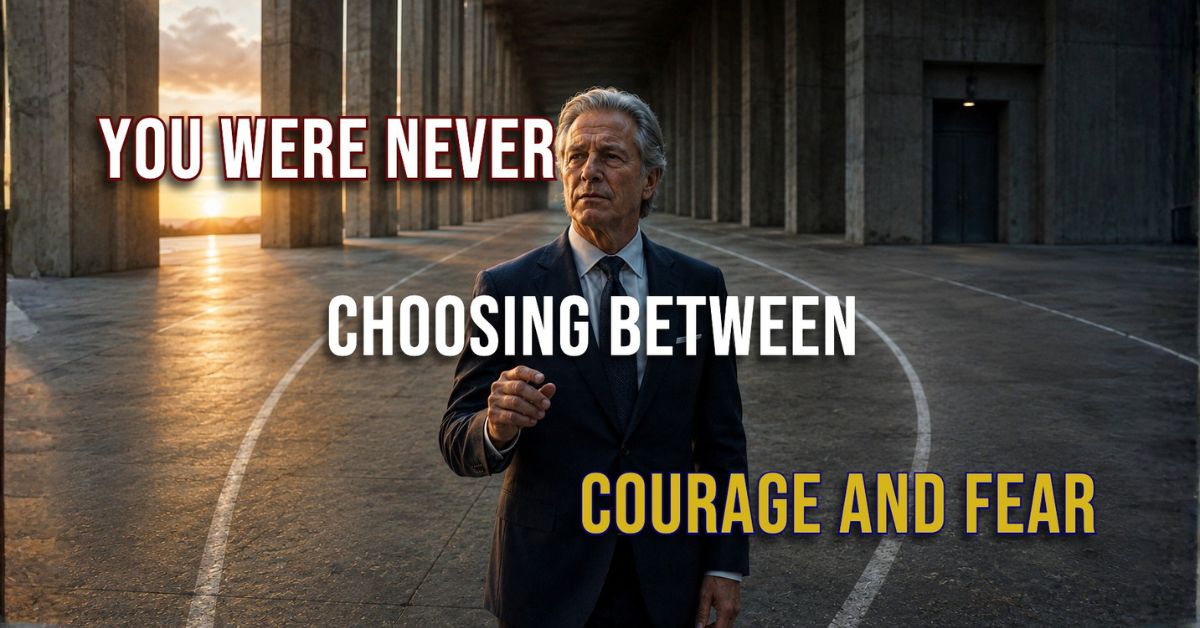
By the time he opened his mouth, he was not choosing between courage and fear.
He was speaking from the meaning already in place.
Why Courage Feels Like a Choice
Courage feels like a choice because you experience it as one.
That moment with his granddaughter looks straightforward. She asked a question, he paused, then he answered.
Some might call his approach courage. Some might call it fear. It’s neither.
We could propose that he answered differently, with more honesty and openness. We could ask him to examine what sat underneath his words.
We describe that space as a decision point, the place where courage is supposedly required.
Most leadership advice agrees: slow down, become aware, choose well, and act with courage when it counts.
None of that is wrong.
The problem is that it assumes awareness is where the decision begins.
That assumption is what makes courage feel like a choice.
The pause he felt was real. His awareness was real. Even the sense that he could answer in more than one way was real.
What was absent in that moment was any examination of how that meaning had formed in him long before he answered her.
What felt like a choice was the continuation of something already in motion before he noticed it. The Innovation Illusion: Why Leaders Block the Very Future They Claim to Want
The Answer Was Already There
By the time he answered her, he was not deciding what to say.
 He was looking at her, but he wasn’t seeing only her. He felt what her question pointed to before he could explain it to himself.
Part of him understood that answering her directly would require him to reconsider what he had just said. It would take him in a different direction, one where the sentence he had offered a few minutes earlier would no longer hold the same weight.
He moved toward what already fit his interpretation. To him, it simply felt natural. The answer carried the certainty of something he had already accepted as true.
Nothing about the answer surprised him.
He did not assemble the response in real time. It arrived with the familiarity of something that had been in place long before the conversation began, long before her question turned his own words back toward him.
When he spoke, he believed he was answering her question. In reality, he was following the interpretation that already felt true to him, which is why the answer never appeared as one possibility among many. It felt like the only answer he could reasonably give.
What He Was Responding To
He was responding to what her question meant to him.
A few minutes earlier, when he first said his words, they sat easily. They carried no pressure because nothing in the moment required him to examine them closely.
When she repeated them back to him and asked what he meant, the words didn’t change, but their position did. They were no longer something he had simply said. They were something he now had to be accountable for.
He didn’t stop to analyze it because the interpretation happened faster than language. Before he could think about the question directly, it had already connected itself to something in him that determined what the question seemed to require.
He could feel that answering her directly would force him back into something he had long stopped questioning and pull his own words open in ways he no longer controlled.
By the time he spoke, her question no longer existed for him in its original form. He was responding to what it had become inside him.
The System That Assigned Meaning
The meaning was not created in the moment the question was asked.
When he answered his granddaughter, it felt as though he was responding to her question, but he was responding from a structure that had already determined what that question meant.
That structure is present every time something is interpreted, not only in difficult conversations.
It is present when a word lands differently than intended, when a tone is judged, or when a situation becomes understood as something specific.
That structure is the Emotional Meaning Architecture©.
It is the system that determines what something means to you before you have time to question it.
It is built over time through repetition, reinforced interpretations, conclusions that are no longer revisited, and patterns that become so familiar they no longer feel like interpretations.
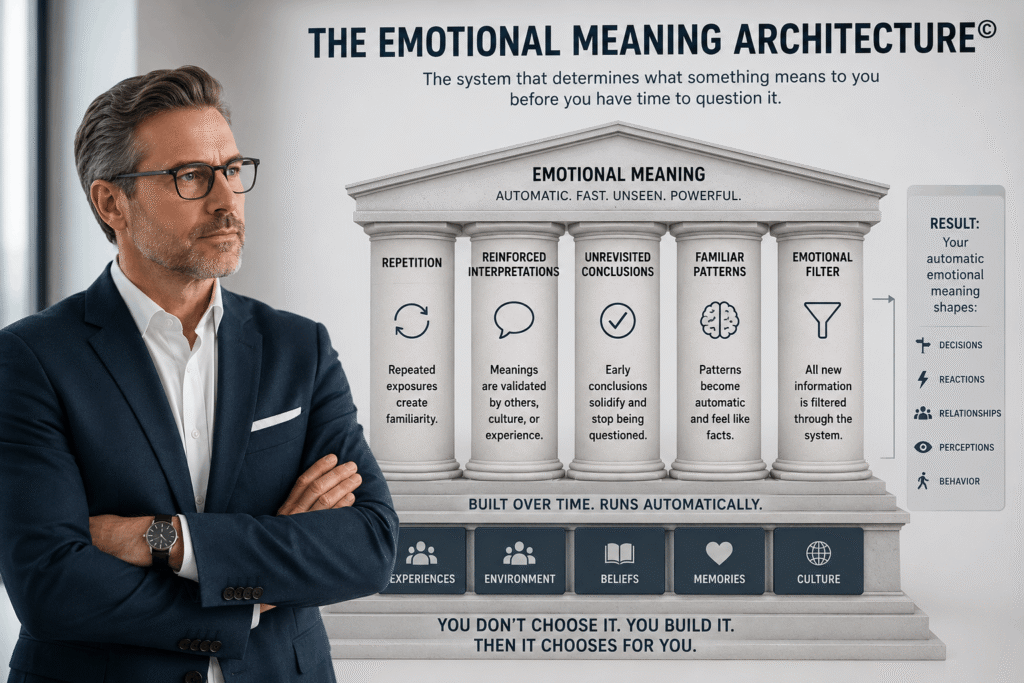
By the time something reaches your awareness, it has already passed through that system and taken on meaning.
His answer felt immediate. The interpretation underneath it had been reinforced long before the question brought it into view.
When his granddaughter asked what he meant, she revealed the certainty already shaping his response. Once that certainty was in place, the answer felt natural because it aligned with what he already experienced as true.
Why Courage and Fear Both Mislead You
Courage and fear are not where the process begins.
When people look back on moments like the one with his granddaughter, they often explain them emotionally. He was afraid to confront something in himself. He lacked courage. He protected what was comfortable instead of questioning what felt true.
Those interpretations feel reasonable because emotion is the part we notice most easily. We notice the tension, the discomfort, and the relief that arrives once the moment passes.
Fear and courage may have been present in the moment, but neither created the response. The response followed a meaning that had been reinforced long before the conversation took place.
Long before he sat at that table with his granddaughter, certain interpretations had become stable enough to feel unquestionable to him. By the time she asked what he meant, the process shaping his answer was already far underway.
Courage alone cannot change a person as deeply as we often hope it will.
People can push through fear, discomfort, and hesitation for a while.
But if the same meaning stays, the same interpretations stay, often disguised as certainty, conviction, courage, or fear.
What drives the response exists beneath emotion and behavior.
How Distorted Meaning Turns Into Action
What feels true to you will eventually shape how you act.
After he answered his granddaughter, nothing dramatic happened. The conversation continued.
It would have been easy to ignore what had just taken place.
Meaning rarely announces itself before it starts shaping behavior. It slips quietly into tone, posture, timing, and choice, influencing what gets defended, avoided, questioned, or left alone.
Once he accepted his interpretation of her question as true, his response followed naturally.
He did not consciously decide to protect himself. The meaning attached to the moment narrowed what felt reasonable to say.
Most people experience behavior as though it appears first.
Behavior is often the final expression of a meaning that existed long before the moment itself.
The same thing happens far beyond a conversation between a grandfather and his granddaughter.
A leader hears disagreement and interprets it as disloyalty. A colleague senses distance and interprets it as rejection. A nation observes movement across a border and interprets it as an act of aggression.
The action that follows feels justified because the meaning underneath it already feels true. Intelligent people can create unnecessary conflict while remaining convinced they are acting rationally. They are responding not only to events themselves, but to the meaning those events have carried for years without examination.
Why You Keep Calling It Something Else
Most people never question the meaning. They only question the outcome.
Most explanations arrive after the damage has already taken shape.
A conversation becomes distant, so we call it miscommunication. A leader shuts people down, so we call it ego. A relationship becomes tense, so we blame stress, timing, pressure, politics, personality, or fatigue.
Those explanations are not entirely wrong. They simply arrive after the deeper process has already taken hold.
 They describe what became visible after the meaning underneath the situation had taken hold.
When an interpretation feels true, the outcome produced by it also feels reasonable. The answer sounds justified, the reaction appropriate, and the withdrawal, defensiveness, certainty, or control all appear connected to the situation itself.
You rarely stop to ask what interpretation made that response feel necessary in the first place.
That was exactly what happened with his granddaughter.
He did not experience himself as avoiding something. To him, he was simply answering her, and his response felt coherent because it aligned with the meaning her question carried for him.
That is how these patterns sustain themselves over time. Attention remains fixed on the behavior, while the meaning that led to it goes unexamined. People spend years trying to improve outcomes without ever questioning the structure that keeps recreating them.
There Is Only One Place Where Meaningful Change Begins
You cannot change a pattern you are still experiencing as truth.
Most attempts at change fail at that exact point.
People adjust their behavior. They work on communication, practice emotional regulation, and try to become more self-aware in moments of tension and pressure.
Sometimes those efforts help, but they rarely reach the place where the response itself is being shaped.
His granddaughter was not challenging his behavior as much as exposing the meaning underneath it, which is why the moment was so difficult for him to recognize clearly.
If he had paused long enough to question why her words landed the way they did, the conversation would have moved differently because he would no longer be responding automatically from the interpretation shaping the moment.

Until that happens, most change remains temporary. Behavior may shift for a while. But if the meaning underneath it remains intact, the deeper pattern reproduces itself.
Until You See It, You Will Repeat It
The patterns that shape your life rarely feel like patterns while you are inside them. They feel like reality.
This is why people can repeat the same conflicts for years, while remaining convinced each situation is completely different from the one before it. The details, faces, and settings change, but the meaning underneath those moments often remains remarkably consistent.
His granddaughter asked a simple question.
 What gave that question its power was not the words themselves, but the meaning connected to them before he answered. By the time he spoke, the direction of his response felt natural because it aligned with something that had settled long before that conversation began.
Most people spend their lives trying to improve the visible parts of this process through confidence, communication, leadership, emotional control, and better decision-making.
Few stop long enough to examine the system underneath those things.
That meaning system determines what feels true before you ever decide how to respond.
Emotional Meaning Architecture© exists because behavior alone cannot explain why people keep creating outcomes they do not want while remaining convinced their responses make sense.
Until you examine the meaning shaping your perception, the same interpretations will continue producing the same kinds of outcomes while still feeling completely justified. People call that certainty, courage, fear, instinct, personality, leadership, even reality itself, without realizing the response was taking shape long before they became aware of it. [See: Courage vs. Power: Navigating the Intricate Psychology and Neuroscience Behind Social Change]
Q&A
Why does courage feel like a conscious choice?
Because awareness often arrives after the meaning that shaped the response has already settled.
What is Emotional Meaning Architecture©?
It is the system that determines what something means to you before you consciously evaluate or respond to it.
With gratitude, respect, and curiosity,
Dov…