“How would you know you’ve found your purpose?” A voice answered, “It would feel right.” And that, right there, is the problem. The meaning you attached to purpose was decided long before you had a say in what felt right.
There’s a man standing on a balcony in Los Angeles. He’s not thinking about purpose. He’s thinking about pain. And without knowing it, he’s standing at the exact location where a discipline begins. Not because pain leads to purpose. Because he realized that the meaning assigned to that pain, before thought, before choice, before survival, is the structure that governs everything that a leader will later call their purpose. That man was me. Now, let’s talk about purpose.
The Question That Keeps Coming Back
You have asked the purpose question sincerely.
Not casually. Not once. You have given it real time, real reflection, and real effort. You have read what needed to be read, attended what promised to deliver, and sat with the question long enough to arrive at answers that felt solid.
And they were solid. The reasoning held. The direction made sense. You were able to explain it clearly and follow your own line of thought without losing the thread.
Then, without anything going wrong, the question came back.
Not because the answer was incomplete. Not because you failed to think it through. It came back feeling exactly as unresolved as it did the first time, as if the clarity you reached had no weight once you moved past it.
So you went back through it again. You were more careful this time, more honest about your assumptions. More willing to question what you thought you already knew.
And you arrived at another answer that felt right. Which also did not hold.
Every year that the question returns is a year the leader operates from a meaning structure they have never examined. Every decision made from that structure, every direction chosen, every version of purpose accepted or dismissed, carries the weight of a filter that was never questioned. The gap between who a leader knows themselves to be and what their leadership actually produces does not close through more effort at this layer. It widens.
At some point, something that cannot be ignored begins to surface. The problem is not in the answers. The answers keep making sense. The problem is the structure that produces those answers. In the part that decides what counts as the right answer before conscious evaluation begins.
That part has never been examined.
Until it is, the question will keep coming back. “What is my purpose?”
What Survival Taught Me That Purpose Work Never Could
I did not find meaning on that balcony in Los Angeles.
I collided with it.
 The pain was not metaphorical. It was the kind that makes the mind unreliable, the kind that willpower cannot reach, and that mindset cannot soften. What I discovered in that moment, not as insight but as structural necessity, was that the meaning I had assigned to that pain was already deciding what felt survivable before I consciously chose anything.
That was not a lesson about resilience. It was not a lesson about purpose.
It was the moment the meaning architecture became visible.
When everything else fails, when the mind cannot comfort you, and the will cannot carry you, what remains is the raw structure of how meaning is being formed: what this experience means, what survival means, and what the next moment means. Those assignments happen before thought arrives. Before language arrives. Before any conscious say in what comes next.
That pattern, the automatic assignment of meaning before conscious choice, did not disappear when the crisis passed. I watched it operate in boardrooms, in high-stakes decisions, in leaders who could not understand why their purpose kept circling without landing.
Same structure. Different circumstances.
What began on that balcony as a confrontation with survival became, across decades of observation and pattern recognition, a discipline that refused to remain unnamed.
The Bizarre Reason Why The Road to Purpose is Paved with Pain
The Meaning Was Already There Before You Asked the Question
Both the balcony and the purpose loop begin the same way.
Not with the question. With a structure that was already active before the question arrived.
When a leader sits down to work through their purpose, it feels like starting fresh. Like bringing honest curiosity to an open question and following the thinking wherever it leads. That feeling is real. The honesty is real. The curiosity is real.
What is not neutral is the structure doing the recognizing.
The meaning architecture governing what will feel like the right answer was formed long before this moment of reflection. It was built through accumulated experience, through emotional patterns that formed under pressure, through inherited narratives about what a meaningful life looks like, through unexamined agreements about what belonging and survival required.
That structure is not waiting passively for the leader to fill it with the right answer. It actively filters which candidates count before evaluation begins.
Which means every answer to the purpose question passes through that filter first. The ones that feel right are the ones the architecture already recognizes. The ones that feel wrong are the ones it removes before the leader has a conscious say in what is seen.
This is not a thinking problem. It is not a commitment problem.
It is a meaning formation problem.
And it cannot be solved at the level of the answers it is producing.
Why the Answers Keep Feeling Right and Failing to Hold
More recently, I wrote about why the purpose search keeps circling back to the same question.
A leader carefully works through the purpose question, arrives at an answer that holds under scrutiny, moves forward with it, and then finds themselves back inside the same question without anything having gone wrong in between. The reasoning was sound. The conclusion made sense.
And yet the question returned.
The answer felt right because it aligned with the meaning architecture that was generating it. It failed to hold because meaning architecture does not change through more thinking, more reflection, or more carefully refined questioning. The leader is not searching from a neutral position. They are searching through a structure that pre-selects what counts as the right answer before conscious evaluation begins.
More effort inside the same structure just produces more certainty, not more resolution.
There is an image that captures this precisely. If you are wearing red lenses and searching for something green, you will keep reaching the conclusion that green does not exist. Not because green is absent. Because the lenses are deciding what reaches you before you have a chance to see what is actually there.
No amount of ‘purpose work’ changes the lenses. The architecture of meaning formation must be examined.
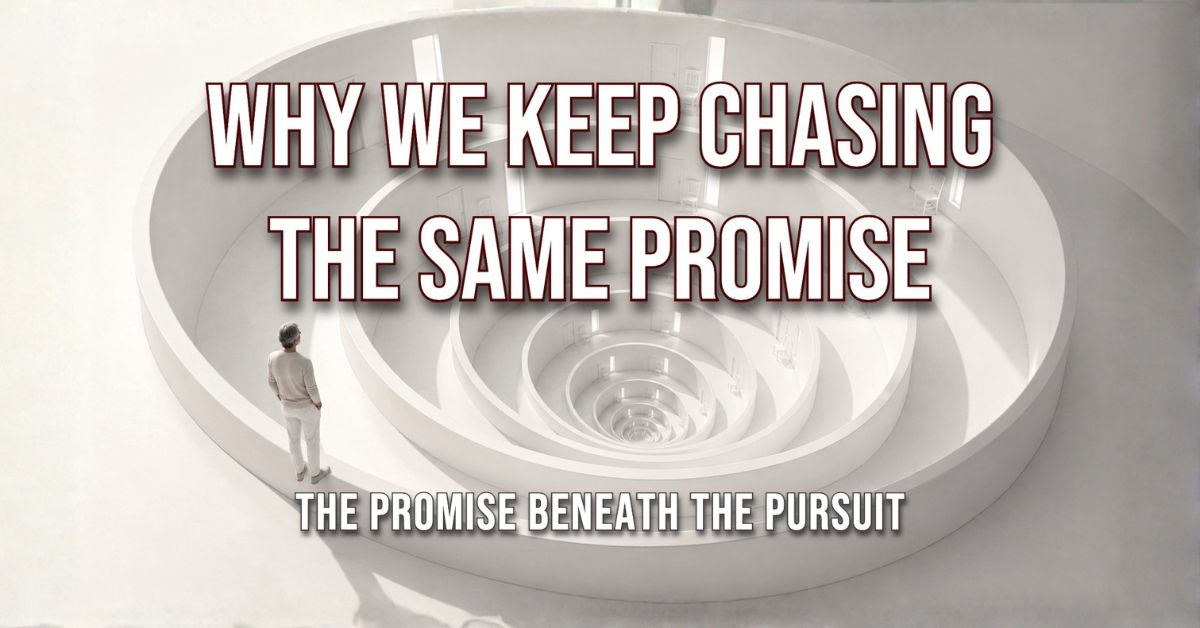
Why Your Search for Purpose Keeps Circling Back
The Structure Beneath the Search Has a Name
The pattern that began on a balcony in Los Angeles and repeated across decades of boardrooms, cultures, and high-stakes leadership moments did not produce a framework.
 It produced a discipline because what kept revealing itself was not a technique gap or a methodology gap. It was a territorial gap. A layer that existed beneath every purpose search, every leadership decision, and every moment of clarity that dissolved before it could hold. A layer that no existing map had been built to enter.
Emotional Meaning Architecture© is the discipline built to work at that layer.
It does not help leaders find purpose. It makes visible the structure that has been filtering what feels like purpose all along. It does not produce better answers to the purpose question. It examines what has been determining the “right” answers before the leader consciously evaluates them.
The discipline is structured around five pillars, each governing a distinct layer of how leaders interpret reality, access emotional power, establish inner authority, reengineer legacy, and undergo identity transformation under pressure.
Perception Mastery. Emotional Dominion. Sovereign Leadership. Legacy Reengineering. Authority Rebirth.
Each pillar addresses a different domain of emotional meaning architecture. United, they form the territory, the territory that the search for purpose has always been circling without knowing it had a name.
What Changes When the Filter Is Examined
This is not a promise. It is a structural consequence.
When emotional meaning architecture is examined, purpose stops feeling like something that needs to be found. Because the leader can finally see what has been answering the purpose question for them all along.
The answers that kept feeling right and failing to hold were not wrong. They were accurate reflections of a structure that had never been questioned. Once that structure becomes visible, the relationship to those answers changes. The leader stops treating certainty as confirmation and starts recognizing it as a signal that the architecture is working exactly as it was built to work, filtering what reaches awareness before conscious evaluation begins.
That shift is not philosophical. It is architectural.
Perceptual filters that once edited reality before it arrived become visible and correctable, meaning formation that once ran automatically becomes something the leader can examine in real-time. And the emotional architecture that made certain answers feel survivable or dangerous begins to loosen its grip.
Purpose does not arrive as a sudden revelation. It emerges as the architecture clears. Not as something found after years of searching. As something that was present all along, filtered by a structure the leader had never been given the tools to see.
The tools now exist.
Purpose Was Never the Destination. It Was Always the Direction.
The purpose question was never wrong.
The search was never a failure. The years spent inside the question, the answers that felt solid and dissolved, the retreats and the frameworks, and the honest reflection that kept returning to the same place, none of that was wasted. It was all pointing at something real.
It was pointing at the filter.
 The man on the balcony in Los Angeles was not searching for purpose. He was colliding with the structure that had been governing what felt meaningful, what felt survivable, and what felt like the right next step, long before he had a conscious say in any of it. That collision did not produce a destination. It produced a direction. A discipline. A map of the territory that the purpose search had always been circling without knowing it had a name.
That territory now has a discipline.
And the question that had been returning for years, the one that kept feeling unresolved despite genuine effort and sound reasoning, was not a sign that purpose had been lost.
It was a signal that the filter had never been examined.
Purpose was never somewhere you had not yet arrived. It was always present, always active, always directing. And the only thing standing between you and that direction was a structure deciding what you were allowed to see before you had a conscious say in it.
That structure can be examined.
The direction has been there all along.
TL;DR
The purpose question keeps returning, not because the answers are wrong, but because the structure producing them has never been examined. Every answer to the purpose question passes through a meaning architecture formed long before the search began, filtering what feels right before conscious evaluation engages. Emotional Meaning Architecture© is the discipline built to work at that layer. When the filter is examined, your purpose does not need to be found. It was never lost.
Q&A
Q: Why do I keep returning to the same purpose question despite genuine effort?
Because every time you work through the question, you are using the same meaning architecture to recognize what counts as the right answer. The answers feel solid because they align with the structure producing them. They fail to hold because that structure has never changed. More effort within the same architecture yields greater certainty, not greater resolution.
Q: Is the problem in how I am thinking about purpose?
The problem is not in your thinking. Your thinking is consistent, and your effort is real. What has not changed is the structure shaping what your thinking recognizes as right. That structure was formed through accumulated experience, emotional patterns, and inherited narratives long before you asked the question. Until it is examined, the search will keep producing answers from the same filter.
Q: What actually changes when the meaning architecture is examined?
The search changes in nature. You stop looking for the answer that will finally resolve the question and start seeing the structure that has been shaping every answer you have ever arrived at. Perceptual filters become visible. Meaning formation that once ran automatically becomes something you can examine in real time. Purpose stops feeling like a destination you have not yet reached and starts revealing itself as a direction that has been present all along, filtered by a structure that was never given the tools to be seen.
With gratitude, respect, and curiosity,
Dov…